

Hotel safety planning for families begins with the people on the trip. A toddler exploring a balcony door, a teenager using a shared device, and a relative who needs a step-free bathroom each raise different questions. A useful plan identifies those needs before arrival and gives the adults clear responsibilities once everyone is tired and distracted.
You do not need an elaborate inspection routine. A few confirmed arrangements, a careful first look at the room, and consistent supervision can make daily decisions easier. Use this guide alongside our hotel room check-in checklist, adapting the questions to your family’s ages and circumstances.
Confirm the arrangements that matter before booking
List the details your family depends on: sleeping spaces, bathroom features, room access, medication storage, and how people will move between rooms. Ask the property to confirm those details for your actual reservation. A photograph of a family suite does not establish the layout of the room you will receive.
If you need connecting rooms, ask whether that arrangement is confirmed or merely requested. Clarify how connecting doors operate and who can access each room. If the hotel cannot confirm an essential feature, consider whether the uncertainty is manageable before paying.
Ask about the pool’s supervision arrangements, access gates, and operating hours. For an infant, request the type of crib or play yard available and whether it can be reserved. Record the answer in your booking notes rather than relying on an amenity icon.
Describe accessibility needs in practical terms, including bathing, sleeping, and evacuation assistance. Our accessible hotel room questions can help you turn a broad request into a discussion of specific features. The traveler who uses the feature should guide that conversation whenever possible.
Plan the arrival itself. Decide who will speak to reception and who will stay with children and luggage. If the room is not ready, ask where your group can wait together. Keep essentials for the first evening accessible so that finding sleepwear or a necessary device does not require unpacking every bag at once.
Give the room a family-focused first look

Keep younger children with an adult while another person checks the room. Look at balcony and window access, obvious furniture instability, loose cords, damaged fittings, and the route between beds and the door. Identify concerns you can report without moving heavy furniture or altering safety devices.
The Consumer Product Safety Commission’s childproofing guidance explains that window screens do not prevent children from falling. Do not treat a screen as a protective barrier or leave a young child unsupervised near an accessible window or balcony. Ask staff about unsuitable arrangements rather than improvising changes to the room.
Choose a consistent place for keys, phones, and necessary documents. Store medicines where children cannot reach them. The CPSC recommends locked, out-of-reach medication storage and original child-resistant containers. A zipped handbag on a low table is not a substitute for appropriate storage.
Plan sleep before everyone is exhausted
Check the sleeping arrangement while there is time to ask for help. For babies, the CPSC’s safe-sleep guidance calls for a suitable infant sleep product, placing the baby on their back, and a sleep space containing only a fitted sheet. An adult hotel bed or improvised nest of pillows is not an equivalent replacement.
Check any supplied crib or play yard
Ask staff to assemble the product according to its instructions. Look for an identifiable model, appropriate mattress, secure setup, and obvious damage. Do not add a second mattress, padding, or makeshift parts to improve the fit. If you are unsure about the product, request clarification before using it.
If the setup is not suitable
Explain the specific issue and ask for another appropriate arrangement. Keep the infant with a responsible caregiver while it is resolved. A promise that “other families use it” does not answer a question about the particular product in your room.
Make pool supervision an explicit handover
Before visiting the pool, decide which adult is supervising each child. Agree that a change of responsibility requires a clear conversation. One adult putting down a book does not necessarily mean another has taken over, especially when several families are together.
Use a direct handover such as “Are you watching both children while I collect the towels?” Wait for a clear answer before leaving. If the supervising adult needs a break and nobody can take over, end the water activity together. Do not assign this responsibility to another child simply because they swim confidently.
Keep attention on the water
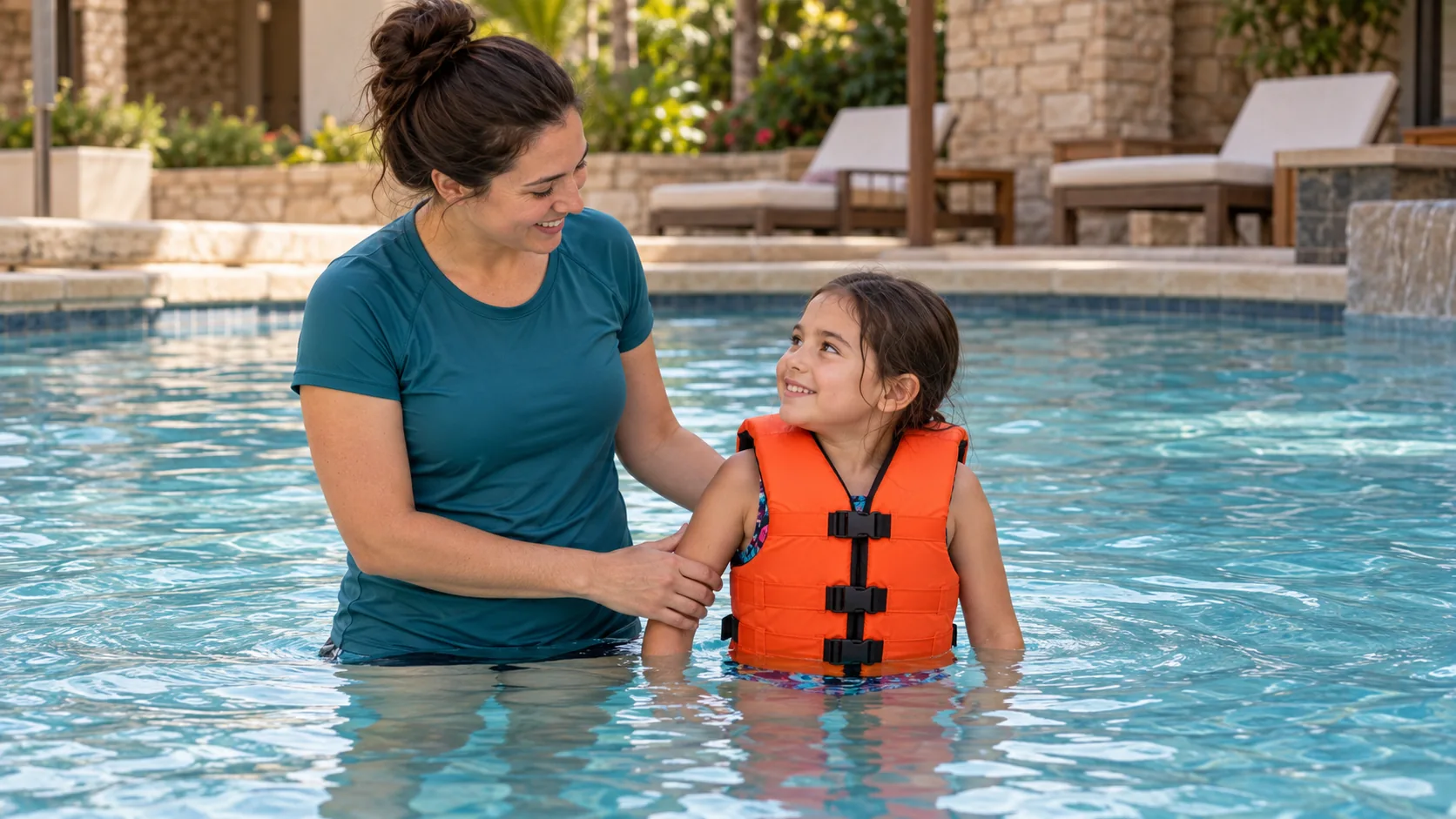
The CDC recommends close, constant supervision around water, including when lifeguards are present. The supervising adult should avoid phone use, reading, alcohol, and other distractions. Children who have taken swimming lessons still need supervision.
Learn the pool’s depth changes and posted rules before entering. Use a properly fitted life jacket appropriate for the wearer and activity, following its instructions. Life jackets can support weaker swimmers, but inflatable toys are not safety devices and no flotation aid replaces supervision. Keep children away from the pool when no responsible adult is actively watching them.
Think beyond swim time. Check how your room and the shared areas connect to water. Close access doors after returning indoors, and remain alert when children are near bathtubs or other water. A hotel pool appearing quiet is not evidence that it is supervised.
Prepare a simple plan for separation or an emergency
Help children understand where the reception desk is and which adult they should stay with. Older children can learn the hotel’s name and how to reach a caregiver. Avoid putting room numbers or other sensitive details on publicly visible belongings.
Save the property address where adults can find it without searching through email. Discuss what to do if someone becomes separated in a shared area. Make the plan realistic for the child’s age, communication needs, and familiarity with the building.
The U.S. Fire Administration advises hotel guests to read the evacuation plan and find the two closest exits. Review the route together and ask staff about assistance needs before an emergency. Our hotel fire safety guide explains the arrival questions to consider.
Revisit the plan when the day changes
After an outing, a room move, or a change of caregiver, briefly check the arrangements again. Confirm who has the keys, who is supervising, and whether medicines, mobility equipment, and sleep essentials are where they should be.
If a feature makes the room unsuitable, describe the problem early and ask for a practical solution. Our guide to requesting a different hotel room can help frame that conversation. A family plan works best when it is clear enough to follow on an ordinary busy evening, not only when everyone has time to concentrate.